
day1
01-求两数之和,给定一个整数数组 nums 和一个整数目标值 target,请你在该数组中找出 和为目标值 target 的那 两个 整数,并返回它们的数组下标。
class Solution {
    public int[] twoSum(int[] nums, int target) {
        //普通做法
        // for(int i = 0; i < nums.length; i++) {
        //     for(int j = i + 1; j < nums.length; j++) {
        //         if (nums[i] + nums[j] == target) {
        //             return new int[]{i, j};
        //         }
        //     }
        // }
        // return null;

        // 使用hashmap,时间复杂度log(n)
        HashMap<Integer, Integer> map = new HashMap<>();
        for(int i = 0; i < nums.length; i++) {
            int temp = target - nums[i];
            if(map.get(temp) != null) {
                return new int[]{i, map.get(temp)};
            } else {
                map.put(nums[i], i);
            }
        }
        return null;
    }
}
02-字母异位词分组,给你一个字符串数组,请你将 字母异位词 组合在一起。可以按任意顺序返回结果列表。
字母异位词 是由重新排列源单词的所有字母得到的一个新单词
class Solution {
    public List<List<String>> groupAnagrams(String[] strs) {
        // 将字母异位词排序得到key,key相同的放一起
         HashMap<String, List<String>> map = new HashMap<>();
         for(String str : strs) {
            char[] arr = str.toCharArray(); // 转换为字符数组
            Arrays.sort(arr);
            String key = new String(arr);
            List<String> list = map.getOrDefault(key, new ArrayList<String>());
            list.add(str);
            map.put(key, list);
         }
         return new ArrayList<List<String>>(map.values());
    }
}
03-最长连续序列,给定一个未排序的整数数组 nums ,找出数字连续的最长序列(不要求序列元素在原数组中连续)的长度。
class Solution {
    public int longestConsecutive(int[] nums) {
        // HashSet去重
        HashSet<Integer> integers = new HashSet<>();
        for(int num : nums) {
            integers.add(num);
        }
        // 从没有num - 1 的 num开始计算
        int cnt = 0;
        for(Integer integer : integers) {
            if (!integers.contains(integer - 1)) {
                int currentCnt = 1;
                int currentNum = integer;
                while(integers.contains(currentNum + 1)) {
                    currentCnt += 1;
                    currentNum += 1;
                }
                cnt = Math.max(cnt, currentCnt);
            }
        }
        return cnt;

    }
}
04-移动零,给定一个数组 nums,编写一个函数将所有 0 移动到数组的末尾,同时保持非零元素的相对顺序。
请注意 ,必须在不复制数组的情况下原地对数组进行操作。
class Solution {
    public void moveZeroes(int[] nums) {
        int left = 0;
        int right = 0;
        while(right < nums.length) {
            if(nums[right] != 0) {
                int temp = nums[left];
                nums[left] = nums[right];
                nums[right] = temp;
                left++;
            }
            right++;
        }
    }
}
05-盛水最多的容器,给定一个长度为 n 的整数数组 height 。有 n 条垂线,第 i 条线的两个端点是 (i, 0) 和 (i, height[i]) ,找出其中的两条线,使得它们与 x 轴共同构成的容器可以容纳最多的水。
class Solution {
    public int maxArea(int[] height) {
        //使用双指针
        int l = 0;
        int r = height.length - 1;
        int maxValue = 0;
        while(r > l) {
            int temp = (r - l) * Math.min(height[l], height[r]);
            maxValue = Math.max(temp, maxValue);
            if(height[r] < height[l]) {
                r--;
            } else {
                l++;
            }
        }
        return maxValue;
    }
}
day2
06-三数之和,给你一个整数数组 nums ,判断是否存在三元组 [nums[i], nums[j], nums[k]] 满足 i != j、i != k 且 j != k ,同时还满足 nums[i] + nums[j] + nums[k] == 0 。请你返回所有和为 0 且不重复的三元组。
注意:答案中不可以包含重复的三元组。
class Solution {
    public List<List<Integer>> threeSum(int[] nums) {
        // 排序
        Arrays.sort(nums);
        List<List<Integer>> res = new ArrayList<>();
        for(int i = 0; i < nums.length; i++) {
            if(i > 0 && nums[i] == nums[i-1]) {// 去重
                continue;
            }
            int target = -nums[i];
            int k = nums.length - 1;
            for(int j = i + 1; j < nums.length; j++) {
                // 去重
                if(j > i + 1 && nums[j] == nums[j-1]) {
                    continue;
                }
                while(j < k && nums[j] + nums[k] > target) {
                    k--;
                }
                // j k 重复不满足
                if(j == k) {
                    break;
                }
                if(nums[j] + nums[k] == target) {
                    List<Integer> list = new ArrayList<>();
                    list.add(nums[i]);
                    list.add(nums[j]);
                    list.add(nums[k]);
                    res.add(list);
                }
            }
        }
        return res;
    }
}
07-接雨水,给定 n 个非负整数表示每个宽度为 1 的柱子的高度图,计算按此排列的柱子,下雨之后能接多少雨水。
class Solution {
    public int trap(int[] height) {

    }
}
day3
08-无重复字符的最长字串,给定一个字符串 s ,请你找出其中不含有重复字符的 最长 子串 的长度。==滑动窗口==
class Solution {
    public int lengthOfLongestSubstring(String s) {
        Set<Character> set = new HashSet<>();
        int cnt = 0;
        char[] cc = s.toCharArray();
        for(int l = 0, r = 0; r < s.length(); r++) {
            while(r < s.length() && set.contains(cc[r])) {
                set.remove(cc[l]);
                l++;
            }
            set.add(cc[r]);
            cnt = Math.max(cnt, r - l + 1);
        }
        return cnt;
    }
}
day4
09-找到字符串中所有字母异位词,给定两个字符串 s 和 p,找到 s 中所有 p 的 异位词 的子串,返回这些子串的起始索引。不考虑答案输出的顺序。
异位词 指由相同字母重排列形成的字符串(包括相同的字符串)。==滑动窗口==
class Solution {
    public List<Integer> findAnagrams(String s, String p) {
        int slen = s.length();
        int plen = p.length();
        if(slen < plen) {
            return new ArrayList<Integer>();
        }
        List<Integer> list = new ArrayList<>();
        // 初始化滑动窗口以及记录p对应的字符串
        int[] a = new int[26];
        int[] b = new int[26];
        for(int i = 0; i < plen; i++) {
            ++a[s.charAt(i) - 'a'];
            ++b[p.charAt(i) - 'a'];
        }
        if(Arrays.equals(a, b)) {
            list.add(0);
        }
        for(int i = 0; i < slen - plen; i++) {
            --a[s.charAt(i) - 'a'];
            ++a[s.charAt(i + plen) - 'a'];
            if(Arrays.equals(a, b)) {
                list.add(i + 1);
            }
        }
        return list;
    }
}
day5
10-和为k的子数组,给你一个整数数组 nums 和一个整数 k ,请你统计并返回 该数组中和为 k 的子数组的个数 。
子数组是数组中元素的连续非空序列.==前缀和==
class Solution {
    public int subarraySum(int[] nums, int k) {
        int cnt = 0, pre = 0;
        HashMap<Integer, Integer> mp = new HashMap<>();
        mp.put(0, 1);
        for(int i = 0; i < nums.length; i++) {
            pre += nums[i];
            if(mp.containsKey(pre - k)) {
                cnt += mp.get(pre - k);
            }
            mp.put(pre, mp.getOrDefault(pre, 0) + 1);
        }
        return cnt;
    }
}
day6
11-滑动窗口最大值,给你一个整数数组 nums,有一个大小为 k 的滑动窗口从数组的最左侧移动到数组的最右侧。你只可以看到在滑动窗口内的 k 个数字。滑动窗口每次只向右移动一位。返回 滑动窗口中的最大值 。
class Solution {
    public int[] maxSlidingWindow(int[] nums, int k) {
        int n = nums.length;
        int[] res = new int[n - k + 1];
        // 创建一个双端队列
        Deque<Integer> deque = new LinkedList<>();
        // 初始化队列
        for(int i = 0; i < k; i++) {
            while(!deque.isEmpty()&&nums[i] >= nums[deque.peekLast()]) {
                deque.pollLast();
            }
            deque.offerLast(i);
        }
        res[0] = nums[deque.peekFirst()];
        for(int i = k; i < n; i++) {
            while(!deque.isEmpty() && nums[i] >= nums[deque.peekLast()]) {// 始终将窗口的最大值放在队列前面
                deque.pollLast();
            }
            deque.offerLast(i);
            while(deque.peekFirst() <= i - k) {// 移除
                deque.pollFirst();
            }
            res[i - k + 1] = nums[deque.peekFirst()];
        }
        return res;
    }
}
day7
12-合并区间,以数组 intervals 表示若干个区间的集合,其中单个区间为 intervals[i] = [starti, endi] 。请你合并所有重叠的区间,并返回 一个不重叠的区间数组,该数组需恰好覆盖输入中的所有区间 。
class Solution {
    public int[][] merge(int[][] intervals) {
        Arrays.sort(intervals, new Comparator<int[]>(){
            @Override
            public int compare(int[] o1, int[] o2) {
                return o1[0] - o2[0]; //升序排序
            }
        });
        int[] pre = intervals[0];
        int k = 0;
        for(int i = 1; i < intervals.length; i++) {
            int[] cur = intervals[i];
            //当前一个数组和前一个数组比较
            if(cur[0] <= pre[1]) {// 左边最大值小于右边最小值
                int maxRight = Math.max(cur[1], pre[1]);// 右边界最大值
                pre = new int[]{pre[0], maxRight};
            } else {// 不包含
                intervals[k++] = pre;
                pre = cur;
            }
        }
        intervals[k++] = pre;
        return Arrays.copyOfRange(intervals, 0, k);// 截断
    }
}
13-轮转数组,给定一个整数数组 nums,将数组中的元素向右轮转 k 个位置,其中 k 是非负数。(数组翻转)
class Solution {
    public void rotate(int[] nums, int k) {
        int n = nums.length;
        k %= n;
        // 数组翻转
        reverse(nums, 0, n - 1);
        reverse(nums, 0, k - 1);
        reverse(nums, k, n - 1);
    }

    public void reverse(int[] nums, int start, int end) {
        while(start <= end) {
            int temp = nums[start];
            nums[start] = nums[end];
            nums[end] = temp;
            start++;
            end--;
        }
    }
}
14-除自身以外数组的乘积,给你一个整数数组 nums,返回 数组 answer ,其中 answer[i] 等于 nums 中除 nums[i] 之外其余各元素的乘积 。题目数据 保证 数组 nums之中任意元素的全部前缀元素和后缀的乘积都在 32 位 整数范围内。请 不要使用除法,且在 O(n) 时间复杂度内完成此题。
class Solution {
    public int[] productExceptSelf(int[] nums) {
        int n = nums.length;
        // 某个位置的左右数组相乘
        int[] left = new int[n];
        left[0] = 1;
        int[] right = new int[n];
        right[n - 1] = 1;
        for(int i = 1;i < n; i++) {
            left[i] = left[i - 1] * nums[i - 1];
        }
        for(int i = n - 2; i >= 0; i--) {
            right[i] = right[i + 1] * nums[i + 1];
        }
        for(int i = 0; i < n; i++) {
            nums[i] = left[i] * right[i];
        }
        return nums;
    }
}
day8
15-矩阵置零,给定一个 *m* x *n* 的矩阵,如果一个元素为 0 ,则将其所在行和列的所有元素都设为 0 。请使用 原地 算法。
class Solution {
    public void setZeroes(int[][] matrix) {
        int m = matrix.length;
        int n = matrix[0].length;
        // 使用标记数组
        boolean[] row = new boolean[m];
        boolean[] col = new boolean[n];
        for(int i = 0; i < m; i++) {
            for(int j = 0; j < n; j++) {
                if(matrix[i][j] == 0) {
                    row[i] = true;
                    col[j] = true;
                }
            }
        }
        for(int i = 0; i < m; i++) {
            for(int j = 0; j < n; j++) {
                if(row[i] || col[j]) {
                    matrix[i][j] = 0;
                }
            }
        }
    }
}
16-螺旋矩阵,给你一个 m 行 n 列的矩阵 matrix ,请按照 顺时针螺旋顺序 ,返回矩阵中的所有元素。(这道题不难,但需要处理边界,理清楚边界的逻辑)
class Solution {
    public List<Integer> spiralOrder(int[][] matrix) {
        int m = matrix.length;
        if(m == 0) {
            return new ArrayList<Integer>();
        }
        List<Integer> list = new ArrayList<>();
        int n = matrix[0].length;
        int startx = 0;
        int starty = 0;
        int offset = 1;
        int count = 1;
        int cnt = Math.min(m ,n);
        for(int k = 0; k < cnt / 2; k++) {
            int i, j;
            // 上边界遍历 左闭右开
            for(j = starty; j < n - offset; j++) {
                list.add(matrix[startx][j]);
            }
            // 右边界遍历
            for(i = startx; i < m - offset; i++) {
                list.add(matrix[i][j]);
            }
            // 下边界遍历
            for(j = n - offset; j > starty; j--) {
                list.add(matrix[i][j]);
            }
            // 左边界遍历
            for(i = m - offset; i > startx; i--) {
                list.add(matrix[i][starty]);
            }
            // 更新边距距离值
            startx++;
            starty++;
            offset++;
        }
        // 如果是奇数
        if((cnt % 2) == 1) {
            if(m > n) {// 剩余中间的那一列
                for(int i = startx; i <= m - offset; i++) {
                    list.add(matrix[i][starty]);
                }
            } else if(m < n) { // 剩余中间的那一行
                for(int j = starty; j <= n - offset; j++) {
                    list.add(matrix[startx][j]);
                }
            } else { // 剩余中间的那一个元素
                list.add(matrix[startx][starty]);
            }
        }
        return list;
    }
}
day9
17-旋转图像, 给定一个 n × n 的二维矩阵 matrix 表示一个图像。请你将图像顺时针旋转 90 度。
你必须在 原地 旋转图像,这意味着你需要直接修改输入的二维矩阵。请不要 使用另一个矩阵来旋转图像。
分两步:先按对角线翻转,再按中间对称轴翻转
class Solution {
    public void rotate(int[][] matrix) {
        int n = matrix.length;
        // 1. 按对角线翻转
        for(int i = 0; i < n; i++) {
            for(int j = 0; j < i; j++) {
                int temp = matrix[i][j];
                matrix[i][j] = matrix[j][i];
                matrix[j][i] = temp;
            }
        }
        // 2. 按中间对称轴翻转
        for(int i = 0; i < n; i++) {
            for(int j = 0; j < n / 2; j++) {
                int temp = matrix[i][j];
                matrix[i][j] = matrix[i][n - j - 1];
                matrix[i][n - j - 1] = temp;
            }
        }
    }
}
18-搜索二维矩阵,编写一个高效的算法来搜索 *m* x *n* 矩阵 matrix 中的一个目标值 target 。该矩阵具有以下特性:
- 每行的元素从左到右升序排列。
- 每列的元素从上到下升序排列。
Z形状走法
class Solution {
    public boolean searchMatrix(int[][] matrix, int target) {
        int m = matrix.length;
        int n = matrix[0].length;
        // Z 形状走法
        int x = 0;
        int y = n - 1;
        while(x < m && y >=0) {
            if(target == matrix[x][y]) {
                return true;
            }
            if(target > matrix[x][y]) {
                x++;
            } else {
                y--;
            }
        }
        return false;
    }
}
day10
19-相交链表
/**
 * Definition for singly-linked list.
 * public class ListNode {
 *     int val;
 *     ListNode next;
 *     ListNode(int x) {
 *         val = x;
 *         next = null;
 *     }
 * }
 */
public class Solution {
    public ListNode getIntersectionNode(ListNode headA, ListNode headB) {
        Set<ListNode> visited = new HashSet<ListNode>();
        ListNode temp = headA;
        while(temp != null) {
            visited.add(temp);
            temp = temp.next;
        }
        temp = headB;
        while(temp != null) {
            if(visited.contains(temp)) {
                return temp;
            }
            temp = temp.next;
        }
        return null;
    }
}
day11
20-反转链表,给你单链表的头节点 head ,请你反转链表,并返回反转后的链表。
保留下一个节点的引用,当前节点下一个节点指向前一个节点,前一个节点向后移,当前节点向后移
/**
 * Definition for singly-linked list.
 * public class ListNode {
 *     int val;
 *     ListNode next;
 *     ListNode() {}
 *     ListNode(int val) { this.val = val; }
 *     ListNode(int val, ListNode next) { this.val = val; this.next = next; }
 * }
 */
class Solution {
    public ListNode reverseList(ListNode head) {
        ListNode prev = null;
        ListNode curr = head;
        while(curr != null) {
            ListNode next = curr.next;
            curr.next = prev;
            prev = curr;
            curr = next;
        }
        return prev;
    }
}
21-回文链表,给你一个单链表的头节点 head ,请你判断该链表是否为回文链表。如果是,返回 true ;否则,返回 false 。回文链表:从前往后遍历节点的值和从后往前遍历节点的值一样
/**
 * Definition for singly-linked list.
 * public class ListNode {
 *     int val;
 *     ListNode next;
 *     ListNode() {}
 *     ListNode(int val) { this.val = val; }
 *     ListNode(int val, ListNode next) { this.val = val; this.next = next; }
 * }
 */
class Solution {
    public boolean isPalindrome(ListNode head) {
        ListNode temp = head;
        int[] arr = new int[100000];
        int k = 0;
        while(temp != null) {
            arr[k++] = temp.val;
            temp = temp.next;
        }
        int start = 0;
        int end = k - 1;
        while(start <= end) {
            if(arr[start] != arr[end]) {
                return false;
            }
            start++;
            end--;
        }
        return true;
    }
}
22-环形链表,给你一个链表的头节点 head ,判断链表中是否有环。
如果链表中有某个节点,可以通过连续跟踪 next 指针再次到达,则链表中存在环。 为了表示给定链表中的环,评测系统内部使用整数 pos 来表示链表尾连接到链表中的位置(索引从 0 开始)。注意:pos 不作为参数进行传递 。仅仅是为了标识链表的实际情况。
如果链表中存在环 ,则返回 true 。 否则,返回 false 。
public class Solution {
    public boolean hasCycle(ListNode head) {
        // 龟兔赛跑算法
        if(head == null || head.next == null) {
            return false;
        }
        ListNode slow = head;
        ListNode fast = head.next;
        while(slow != fast) {
            if(fast == null || fast.next == null) {
                return false;
            }
            // fast 移动 快于 slow
            // 如果有回环总会相遇,即slow == fast
            slow = slow.next;
            fast = fast.next.next;
        }
        return true;
    }
}
day12
23-环形链表II,给定一个链表的头节点 head ,返回链表开始入环的第一个节点。 如果链表无环,则返回 null。
如果链表中有某个节点,可以通过连续跟踪 next 指针再次到达,则链表中存在环。 为了表示给定链表中的环,评测系统内部使用整数 pos 来表示链表尾连接到链表中的位置(索引从 0 开始)。如果 pos 是 -1,则在该链表中没有环。注意:pos 不作为参数进行传递,仅仅是为了标识链表的实际情况。
不允许修改 链表。
/**
 * Definition for singly-linked list.
 * class ListNode {
 *     int val;
 *     ListNode next;
 *     ListNode(int x) {
 *         val = x;
 *         next = null;
 *     }
 * }
 */
public class Solution {
    public ListNode detectCycle(ListNode head) {
        if(head == null) {
            return null;
        }
        HashSet<ListNode> set = new HashSet<>();
        ListNode cur = head;
        while(cur != null) {
            if(set.contains(cur)) {
                return cur;
            }
            set.add(cur);
            cur = cur.next;
        }
        return null;
    }
}
24-合并两个有序链表,将两个升序链表合并为一个新的 升序 链表并返回。新链表是通过拼接给定的两个链表的所有节点组成的。
/**
 * Definition for singly-linked list.
 * public class ListNode {
 *     int val;
 *     ListNode next;
 *     ListNode() {}
 *     ListNode(int val) { this.val = val; }
 *     ListNode(int val, ListNode next) { this.val = val; this.next = next; }
 * }
 */
class Solution {
    public ListNode mergeTwoLists(ListNode list1, ListNode list2) {
        if(list1 == null) {
            return list2;
        }
        if(list2 == null) {
            return list1;
        }
        ListNode a = list1;
        ListNode b = list2;
        ListNode res = null;
        if(a.val > b.val) {
                res = b;
                b = b.next;
        } else {
                res = a;
                a = a.next;
        }
        ListNode temp = res;
        while(a != null && b != null) {
            if(a.val > b.val) {
                temp.next = b;
                b = b.next;
            } else {
                temp.next = a;
                a = a.next;
            }
            temp = temp.next;
        }
        while(a != null) {
            temp.next = a;
            a = a.next;
            temp = temp.next;
        }
        while(b != null) {
            temp.next = b;
            b = b.next;
            temp = temp.next;
        }
        return res;
    }
}
day13
2024-11-23
25-两数相加,给你两个 非空 的链表,表示两个非负的整数。它们每位数字都是按照 逆序 的方式存储的,并且每个节点只能存储 一位 数字。
请你将两个数相加,并以相同形式返回一个表示和的链表。
/**
 * Definition for singly-linked list.
 * public class ListNode {
 *     int val;
 *     ListNode next;
 *     ListNode() {}
 *     ListNode(int val) { this.val = val; }
 *     ListNode(int val, ListNode next) { this.val = val; this.next = next; }
 * }
 */
 /**
 1.相加
 2.处理进位

 出现的情况:l1长度 >= l2长度 l2长度 > l1长度 末尾进位
  */
class Solution {
    public ListNode addTwoNumbers(ListNode l1, ListNode l2) {
        // 遍历相加
        ListNode h1 = l1;
        ListNode h2 = l2;
        while(h1 != null) {
            if(h2 != null) {
                h1.val = h1.val + h2.val;
                h2 = h2.next;
            }
            // l2 长度大于 l1长度时
            if(h1.next == null && h2 != null) {
                h1.next = h2;
                break;
            }
            h1 = h1.next;
        }
        // 进位
        merge(l1);
        return l1;
    }

    public void merge(ListNode head) {
        while(head != null) {
            if(head.val >= 10) {
                head.val = head.val % 10;
                // 处理末尾进位
                if(head.next == null) {
                    head.next = new ListNode(0);
                }
                head.next.val += 1;
            }
            head = head.next;
        }
    }
}
day14
26-删除链表的倒数第N个结点,给你一个链表,删除链表的倒数第 n 个结点,并且返回链表的头结点。
/**
 * Definition for singly-linked list.
 * public class ListNode {
 *     int val;
 *     ListNode next;
 *     ListNode() {}
 *     ListNode(int val) { this.val = val; }
 *     ListNode(int val, ListNode next) { this.val = val; this.next = next; }
 * }
 */
class Solution {
    public ListNode removeNthFromEnd(ListNode head, int n) {
        ArrayList<ListNode> arr = new ArrayList<>();
        if(head == null) {
            return null;
        }
        int len = 0;
        ListNode temp = head;
        while(temp != null) {
            arr.add(temp);
            len++;
            temp = temp.next;
        }
        // len -n 移除
        if(arr.size() == 1) { // 只有一个元素时
            return null;
        }
        ListNode del = arr.get(len - n);
        // 删除的元素为最左边的元素
        if(len - n == 0) {
            return del.next;
        }
        ListNode pre = arr.get(len - n - 1);
        pre.next = del.next;
        return head;
    }
}
27-两两交换链表中的节点,给你一个链表,两两交换其中相邻的节点,并返回交换后链表的头节点。你必须在不修改节点内部的值的情况下完成本题(即,只能进行节点交换)。
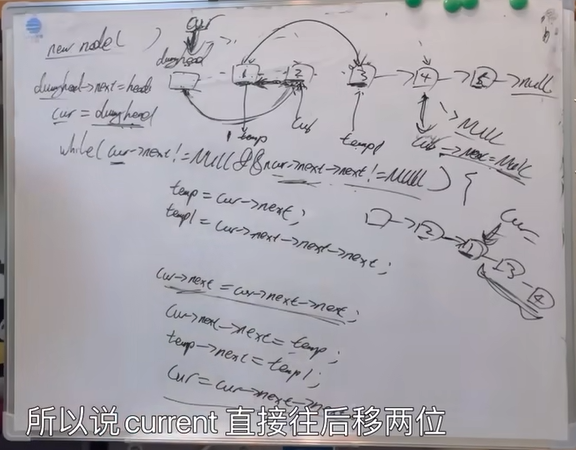
/**
 * Definition for singly-linked list.
 * public class ListNode {
 *     int val;
 *     ListNode next;
 *     ListNode() {}
 *     ListNode(int val) { this.val = val; }
 *     ListNode(int val, ListNode next) { this.val = val; this.next = next; }
 * }
 */
class Solution {
    public ListNode swapPairs(ListNode head) {
        if(head == null) {
            return null;
        }
        // 虚拟头结点
        ListNode a = new ListNode();
        a.next = head;
        // 当前结点
        ListNode curr = a;
        while(curr.next != null && curr.next.next != null) {
            ListNode temp1 = curr.next;
            ListNode temp2 = curr.next.next.next;
            curr.next = curr.next.next;
            curr.next.next = temp1;
            temp1.next = temp2;
            curr = curr.next.next;
        }
        return a.next;
    }
}
day15
28-k个一组翻转链表,给你链表的头节点 head ,每 k 个节点一组进行翻转,请你返回修改后的链表。
k 是一个正整数,它的值小于或等于链表的长度。如果节点总数不是 k 的整数倍,那么请将最后剩余的节点保持原有顺序。
你不能只是单纯的改变节点内部的值,而是需要实际进行节点交换。
/**
 * Definition for singly-linked list.
 * public class ListNode {
 *     int val;
 *     ListNode next;
 *     ListNode() {}
 *     ListNode(int val) { this.val = val; }
 *     ListNode(int val, ListNode next) { this.val = val; this.next = next; }
 * }
 */
class Solution {
    public ListNode reverseKGroup(ListNode head, int k) {
        // 虚拟头结点
        ListNode dummy = new ListNode(-1);
        dummy.next = head;
        // pre节点
        ListNode pre = dummy;
        // end节点
        ListNode end = dummy;
        // while循环找到翻转的尾部
        while(end.next != null) {
            for(int i = 0; i < k && end != null; i++) {
                end = end.next;
            }
            if(end == null) {// 不够k个元素
                break;
            }
            // 记录下一次开始的节点
            ListNode next = end.next;
            end.next = null;
            // 记录当前头结点
            ListNode start = pre.next;
            pre.next = null;
            // 翻转链表
            pre.next = reverseList(start);
            // 恢复null
            start.next = next;
            pre = start;
            end = start;
        }
        return dummy.next;
    }

    public ListNode reverseList(ListNode head) {
        ListNode pre = null;
        ListNode curr = head;
        while(curr != null) {
            ListNode next = curr.next;
            curr.next = pre;
            pre = curr;
            curr = next;
        }
        return pre;
    }
}
29-随机链表的复制
/*
// Definition for a Node.
class Node {
    int val;
    Node next;
    Node random;

    public Node(int val) {
        this.val = val;
        this.next = null;
        this.random = null;
    }
}
*/

class Solution {

    Map<Node, Node> map = new HashMap<>();

    public Node copyRandomList(Node head) {
        // 采用递归的方式
        if(head == null) {
            return null;
        }
        if(!map.containsKey(head)) {
            Node newNode = new Node(head.val);
            map.put(head, newNode);
            newNode.next = copyRandomList(head.next);
            newNode.random = copyRandomList(head.random);
        }
        return map.get(head);
    }
}
day16
30-排序链表,给你链表的头结点 head ,请将其按 升序 排列并返回 排序后的链表 。
/**
 * Definition for singly-linked list.
 * public class ListNode {
 *     int val;
 *     ListNode next;
 *     ListNode() {}
 *     ListNode(int val) { this.val = val; }
 *     ListNode(int val, ListNode next) { this.val = val; this.next = next; }
 * }
 */
class Solution {
    public ListNode sortList(ListNode head) {
        if(head == null) {
            return null;
        }
        ListNode curr = head;
        int n = 0;// 算出长度
        while(curr != null) {
            n++;
            curr = curr.next;
        }
        // 存放到数组中
        ListNode[] list = new ListNode[n];
        for(int i = 0; i < n; i++) {
            list[i] = head;
            head = head.next;
        }
        // 排序
        Arrays.sort(list, new Comparator<ListNode>(){
            @Override
            public int compare(ListNode l1, ListNode l2) {
                return l1.val - l2.val; //升序
            }
        });
        for(int i = 0; i < n - 1; i++) {
            list[i].next = list[i+1];
        }
        // 防止循环
        list[n-1].next = null;
        return list[0];
    }
}
31-LRU, 请你设计并实现一个满足 LRU (最近最少使用) 缓存 约束的数据结构。
实现 LRUCache 类:
LRUCache(int capacity)以 正整数 作为容量capacity初始化 LRU 缓存int get(int key)如果关键字key存在于缓存中,则返回关键字的值,否则返回-1。void put(int key, int value)如果关键字key已经存在,则变更其数据值value;如果不存在,则向缓存中插入该组key-value。如果插入操作导致关键字数量超过capacity,则应该 逐出 最久未使用的关键字。
函数 get 和 put 必须以 O(1) 的平均时间复杂度运行。
class LRUCache {
    // 双向链表
    class DlinkedNode{
        int key;
        int value;
        DlinkedNode prev;
        DlinkedNode next;
        public DlinkedNode() {
        }
        public DlinkedNode(int _key, int _value) {
            key = _key;
            value = _value;
        }
    }
    // 哈希表
    private Map<Integer, DlinkedNode> cacah = new HashMap<Integer, DlinkedNode>();
    private int size;
    private int capacity;
    // 虚拟头,尾节点
    private DlinkedNode head, tail;
    public LRUCache(int capacity) {
        this.size = 0;
        this.capacity = capacity;
        // 初始化虚拟头,尾节点
        head = new DlinkedNode();
        tail = new DlinkedNode();
        head.next = tail;
        tail.prev = head;
    }

    public int get(int key) {
        DlinkedNode node = cacah.get(key);
        if(node == null) {
            return -1;
        }
        // 如果key存在,则先通过hash表定位,再移动到头部
        moveToHead(node);
        return node.value;
    }

    public void put(int key, int value) {
        DlinkedNode node = cacah.get(key);
        if(node == null) {
            // key不存在,创建一个
            DlinkedNode newNode = new DlinkedNode(key, value);
            // 添加进hash表
            cacah.put(key, newNode);
            // 添加到双向链表的头部
            addToHead(newNode);
            ++size;
            // 判断size是否大于capacity
            if(size > capacity) {
                // 超出容量,删除尾部节点
                DlinkedNode tail = removeTail();
                // 删除hash表中对应的项
                cacah.remove(tail.key);
                --size;
            }
        } else {
            node.value = value;
            // 移动到链表前面
            moveToHead(node);
        }
    }

    // 将元素移动到头部
    private void moveToHead(DlinkedNode node) {
        // 先移除节点
        removeNode(node);
        // 添加到头部
        addToHead(node);
    }

    // 移除元素
    private void removeNode(DlinkedNode node) {
        node.prev.next = node.next;
        node.next.prev = node.prev;
    }

    // 添加元素到头部
    private void addToHead(DlinkedNode node) {
        node.prev = head;
        node.next = head.next;
        head.next.prev = node;
        head.next = node;
    }

    // 删除尾部节点
    private DlinkedNode removeTail() {
        DlinkedNode res = tail.prev;
        removeNode(res);
        return res;
    }
}

/**
 * Your LRUCache object will be instantiated and called as such:
 * LRUCache obj = new LRUCache(capacity);
 * int param_1 = obj.get(key);
 * obj.put(key,value);
 */
32-合并k个升序链表,给你一个链表数组,每个链表都已经按升序排列。
请你将所有链表合并到一个升序链表中,返回合并后的链表。
/**
 * Definition for singly-linked list.
 * public class ListNode {
 *     int val;
 *     ListNode next;
 *     ListNode() {}
 *     ListNode(int val) { this.val = val; }
 *     ListNode(int val, ListNode next) { this.val = val; this.next = next; }
 * }
 */
class Solution {
    public ListNode mergeKLists(ListNode[] lists) {
        if(lists.length == 0) {
            return null;
        }
        int len = lists.length;
        int n = 0;
        for(int i = 0; i < len; i++) {
            ListNode cur = lists[i];
            while(cur != null) {
                n++;
                cur = cur.next;
            }
        }
        if(n == 0) {
            return null;
        }
        ListNode[] arr = new ListNode[n];
        int k = 0;
        for(int i = 0; i < len; i++) {
            ListNode cur = lists[i];
            while(cur != null) {
                arr[k++] = cur;
                cur = cur.next;
            }
        }
        if(n == 1) {
            return arr[0];
        }
        Arrays.sort(arr, new Comparator<ListNode>() {
            @Override
            public int compare(ListNode n1, ListNode n2) {
                return n1.val - n2.val;
            }
        });
        for(int i = 0; i < n - 1; i++) {
            arr[i].next = arr[i+1];
        }
        arr[n-1] = null;
        return arr[0];
    }
}
day17
33-二叉树的中序遍历,给定一个二叉树的根节点 root ,返回 它的 中序 遍历 。
/**
 * Definition for a binary tree node.
 * public class TreeNode {
 *     int val;
 *     TreeNode left;
 *     TreeNode right;
 *     TreeNode() {}
 *     TreeNode(int val) { this.val = val; }
 *     TreeNode(int val, TreeNode left, TreeNode right) {
 *         this.val = val;
 *         this.left = left;
 *         this.right = right;
 *     }
 * }
 */
class Solution {
    public List<Integer> inorderTraversal(TreeNode root) {
        List<Integer> res = new ArrayList<Integer>();
        inorder(root, res);
        return res;
    }
    public void inorder(TreeNode node, List<Integer> res) {
        if(node == null) {
            return;
        }
        // 左 中 右
        inorder(node.left, res);
        res.add(node.val);
        inorder(node.right, res);
    }
}
34-二叉树最大深度,二叉树的 最大深度 是指从根节点到最远叶子节点的最长路径上的节点数。
/**
 * Definition for a binary tree node.
 * public class TreeNode {
 *     int val;
 *     TreeNode left;
 *     TreeNode right;
 *     TreeNode() {}
 *     TreeNode(int val) { this.val = val; }
 *     TreeNode(int val, TreeNode left, TreeNode right) {
 *         this.val = val;
 *         this.left = left;
 *         this.right = right;
 *     }
 * }
 */
class Solution {
    public int maxDepth(TreeNode root) {
        if(root == null) {
            return 0;
        } else {
            int leftHeight = maxDepth(root.left);
            int rightHeight = maxDepth(root.right);
            return Math.max(leftHeight, rightHeight) + 1;
        }
    }
}
35-翻转二叉树,给你一棵二叉树的根节点 root ,翻转这棵二叉树,并返回其根节点。
/**
 * Definition for a binary tree node.
 * public class TreeNode {
 *     int val;
 *     TreeNode left;
 *     TreeNode right;
 *     TreeNode() {}
 *     TreeNode(int val) { this.val = val; }
 *     TreeNode(int val, TreeNode left, TreeNode right) {
 *         this.val = val;
 *         this.left = left;
 *         this.right = right;
 *     }
 * }
 */
// 后续遍历
class Solution {
    public TreeNode invertTree(TreeNode root) {
        if(root == null) {
            return null;
        }
        TreeNode left = invertTree(root.left);
        TreeNode right = invertTree(root.right);
        root.left = right;
        root.right = left;
        return root;
    }
}
day18
36-对称二叉树
/**
 * Definition for a binary tree node.
 * public class TreeNode {
 *     int val;
 *     TreeNode left;
 *     TreeNode right;
 *     TreeNode() {}
 *     TreeNode(int val) { this.val = val; }
 *     TreeNode(int val, TreeNode left, TreeNode right) {
 *         this.val = val;
 *         this.left = left;
 *         this.right = right;
 *     }
 * }
 */
// 后续遍历
class Solution {
    public boolean isSymmetric(TreeNode root) {
        return check(root.left, root.right);
    }
    public boolean check(TreeNode p, TreeNode q) {
        if(p == null && q == null) {
            return true;
        }
        if(p == null || q == null) {
            return false;
        }
        return p.val == q.val && check(p.left, q.right) && check(p.right, q.left);
    }
}
37-二叉树的直径,给你一棵二叉树的根节点,返回该树的 直径 。
二叉树的 直径 是指树中任意两个节点之间最长路径的 长度 。这条路径可能经过也可能不经过根节点 root 。
两节点之间路径的 长度 由它们之间边数表示。
/**
 * Definition for a binary tree node.
 * public class TreeNode {
 *     int val;
 *     TreeNode left;
 *     TreeNode right;
 *     TreeNode() {}
 *     TreeNode(int val) { this.val = val; }
 *     TreeNode(int val, TreeNode left, TreeNode right) {
 *         this.val = val;
 *         this.left = left;
 *         this.right = right;
 *     }
 * }
 */
 // 对于一个节点,左儿子节点的最大深度为 l 右儿子节点最大深度为 r
 // l(左二子节点数) + r(右儿子节点数) + 1(根) = (res)最大路径节点数
 // 最大路径长度为 = res - 1
class Solution {
    int res;
    public int diameterOfBinaryTree(TreeNode root) {
        res = 0;
        dept(root);
        return res - 1;
    }
    public int dept(TreeNode node) {
        if(node == null) {
            return 0;
        }
        int l = dept(node.left);
        int r = dept(node.right);
        // 遍历的节点数量
        res = Math.max(res, l + r + 1);
        return Math.max(l, r) + 1;
    }
}
38-二叉树的层序遍历,给你二叉树的根节点 root ,返回其节点值的 层序遍历 。 (即逐层地,从左到右访问所有节点)。==广度优先搜索==
/**
 * Definition for a binary tree node.
 * public class TreeNode {
 *     int val;
 *     TreeNode left;
 *     TreeNode right;
 *     TreeNode() {}
 *     TreeNode(int val) { this.val = val; }
 *     TreeNode(int val, TreeNode left, TreeNode right) {
 *         this.val = val;
 *         this.left = left;
 *         this.right = right;
 *     }
 * }
 */
 // 采用广度优先搜索的方式 + 队列
class Solution {
    public List<List<Integer>> levelOrder(TreeNode root) {
        List<List<Integer>> res = new ArrayList<List<Integer>>();
        if(root == null) {
            return res;
        }
        // 创建一个队列
        Queue<TreeNode> queue = new LinkedList<TreeNode>();
        queue.offer(root);
        while(!queue.isEmpty()) {
            List<Integer> level = new ArrayList<Integer>();
            int size = queue.size();
            for(int i = 0; i < size; i++) {
                TreeNode node = queue.poll();
                level.add(node.val);
                if(node.left != null) {
                    queue.offer(node.left);
                }
                if(node.right != null) {
                    queue.offer(node.right);
                }
            }
            res.add(level);
        }
        return res;
    }
}
day19
39-将有序数组转换为二叉搜索树,给你一个整数数组 nums ,其中元素已经按 升序 排列,请你将其转换为一棵 平衡 二叉搜索树。
/**
 * Definition for a binary tree node.
 * public class TreeNode {
 *     int val;
 *     TreeNode left;
 *     TreeNode right;
 *     TreeNode() {}
 *     TreeNode(int val) { this.val = val; }
 *     TreeNode(int val, TreeNode left, TreeNode right) {
 *         this.val = val;
 *         this.left = left;
 *         this.right = right;
 *     }
 * }
 */
 // 二叉树的中序遍历刚好是升序数组
class Solution {
    public TreeNode sortedArrayToBST(int[] nums) {
         return solve(nums, 0, nums.length - 1);
    }

    public TreeNode solve(int[] nums, int left, int right) {
        if(left > right) {
            return null;
        }
        int mid = (right - left) / 2 + left;
        TreeNode root = new TreeNode(nums[mid]);
        root.left = solve(nums, left, mid - 1);
        root.right = solve(nums, mid + 1, right);
        return root;
    }
}
40-验证二叉搜索树,给你一个二叉树的根节点 root ,判断其是否是一个有效的二叉搜索树。
有效 二叉搜索树定义如下:
-
节点的左
子树
只包含
小于
当前节点的数。
-
节点的右子树只包含 大于 当前节点的数。
-
所有左子树和右子树自身必须也是二叉搜索树。
/**
 * Definition for a binary tree node.
 * public class TreeNode {
 *     int val;
 *     TreeNode left;
 *     TreeNode right;
 *     TreeNode() {}
 *     TreeNode(int val) { this.val = val; }
 *     TreeNode(int val, TreeNode left, TreeNode right) {
 *         this.val = val;
 *         this.left = left;
 *         this.right = right;
 *     }
 * }
 */
class Solution {
    public boolean isValidBST(TreeNode root) {
        return solve(root, Long.MIN_VALUE, Long.MAX_VALUE);
    }

    public boolean solve(TreeNode root, long lower, long upper) {
        if(root == null) {
            return true;
        }
        if(root.val <= lower || root.val >= upper) {
            return false;
        }
        return solve(root.left, lower, root.val) && solve(root.right, root.val, upper);
    }
}
41-二叉搜索树中的第k小的元素,给定一个二叉搜索树的根节点 root ,和一个整数 k ,请你设计一个算法查找其中第 k 小的元素(从 1 开始计数)。
/**
 * Definition for a binary tree node.
 * public class TreeNode {
 *     int val;
 *     TreeNode left;
 *     TreeNode right;
 *     TreeNode() {}
 *     TreeNode(int val) { this.val = val; }
 *     TreeNode(int val, TreeNode left, TreeNode right) {
 *         this.val = val;
 *         this.left = left;
 *         this.right = right;
 *     }
 * }
 */
 // 采用中序遍历,遍历得到的顺序就是升序的顺序
class Solution {

    public static Integer target = 0;
    public static Integer cnt = 0;
    public int kthSmallest(TreeNode root, int k) {
        cnt = k;
        solve(root);
        return target;
    }

    public void solve(TreeNode root) {
        if(root == null) {
            return;
        }
        solve(root.left);
        if(--cnt == 0) {
            target = root.val;
        }
        solve(root.right);
    }
}
day20
42-二叉树的右视图,给定一个二叉树的 根节点 root,想象自己站在它的右侧,按照从顶部到底部的顺序,返回从右侧所能看到的节点值。
/**
 * Definition for a binary tree node.
 * public class TreeNode {
 *     int val;
 *     TreeNode left;
 *     TreeNode right;
 *     TreeNode() {}
 *     TreeNode(int val) { this.val = val; }
 *     TreeNode(int val, TreeNode left, TreeNode right) {
 *         this.val = val;
 *         this.left = left;
 *         this.right = right;
 *     }
 * }
 */
 // 采用广度优先搜索方法
class Solution {
    public List<Integer> rightSideView(TreeNode root) {
        List<Integer> res = new ArrayList<Integer>();
        if(root == null) {
            return res;
        }
        // 定义双端队列
        Queue<TreeNode> queue = new LinkedList<TreeNode>();
        queue.offer(root);
        while(!queue.isEmpty()) {
            int size = queue.size();
            for(int i = 0; i < size; i++) {
                TreeNode node = queue.poll();
                if(i == size - 1) {
                    res.add(node.val);
                }
                if(node.left != null) {
                    queue.offer(node.left);
                }
                if(node.right != null) {
                    queue.offer(node.right);
                }
            }
        }
        return res;
    }
}
43-二叉树展开为链表,给你二叉树的根结点 root ,请你将它展开为一个单链表:
展开后的单链表应该同样使用 TreeNode ,其中 right 子指针指向链表中下一个结点,而左子指针始终为 null 。
展开后的单链表应该与二叉树 先序遍历 顺序相同。
/**
 * Definition for a binary tree node.
 * public class TreeNode {
 *     int val;
 *     TreeNode left;
 *     TreeNode right;
 *     TreeNode() {}
 *     TreeNode(int val) { this.val = val; }
 *     TreeNode(int val, TreeNode left, TreeNode right) {
 *         this.val = val;
 *         this.left = left;
 *         this.right = right;
 *     }
 * }
 */
// 主要考察先序遍历
class Solution {
    public void flatten(TreeNode root) {
        List<TreeNode> list = new ArrayList<TreeNode>();
        solve(root, list);
        int size = list.size();
        for(int i = 0; i < size - 1; i++) {
            TreeNode temp = list.get(i);
            temp.right = list.get(i + 1);
            temp.left = null;
        }
    }
    public void solve(TreeNode root, List<TreeNode> list) {
        if(root == null) {
            return;
        }
        list.add(root);
        solve(root.left, list);
        solve(root.right, list);
    }
}
44-从前序遍历与中序遍历序列构造二叉树,给定两个整数数组 preorder 和 inorder ,其中 preorder 是二叉树的先序遍历, inorder 是同一棵树的中序遍历,请构造二叉树并返回其根节点。
/**
 * Definition for a binary tree node.
 * public class TreeNode {
 *     int val;
 *     TreeNode left;
 *     TreeNode right;
 *     TreeNode() {}
 *     TreeNode(int val) { this.val = val; }
 *     TreeNode(int val, TreeNode left, TreeNode right) {
 *         this.val = val;
 *         this.left = left;
 *         this.right = right;
 *     }
 * }
 */
class Solution {
    public TreeNode buildTree(int[] preorder, int[] inorder) {
        return solve(preorder, 0, preorder.length - 1, inorder, 0, inorder.length - 1);
    }

    public TreeNode solve(int[] preorder, int preStart, int preEnd,
    int[] inorder,int inStart, int inEnd) {
        // 终止条件
        if(preStart > preEnd || inStart > inEnd) {
            return null;
        }
        // 提取根节点
        int rootVal = preorder[preStart];
        TreeNode root = new TreeNode(rootVal);

        // 中序遍历中找到根节点的位置
        int rootIndex = -1;
        for(int i = inStart; i <= inEnd; i++) {
            if(rootVal == inorder[i]) {
                rootIndex = i;
                break;
            }
        }
        // 左子树个数
        int leftCnt = rootIndex - inStart;

        // 这里的下标需要好好理解
        // 构建左子树
        root.left = solve(preorder, preStart + 1, preStart + leftCnt,
        inorder, inStart, rootIndex - 1);
        // 构建右子树
        root.right = solve(preorder, preStart + leftCnt + 1, preEnd,
        inorder, rootIndex + 1, inEnd);
        return root;
    }
}
45-路径总和,给定一个二叉树的根节点 root ,和一个整数 targetSum ,求该二叉树里节点值之和等于 targetSum 的 路径 的数目。
路径 不需要从根节点开始,也不需要在叶子节点结束,但是路径方向必须是向下的(只能从父节点到子节点)。
https://www.bilibili.com/video/BV1UU4y1A7BE/?spm_id_from=333.337.search-card.all.click&vd_source=32fb884356739c022c7ef3750cdd7abe
/**
 * Definition for a binary tree node.
 * public class TreeNode {
 *     int val;
 *     TreeNode left;
 *     TreeNode right;
 *     TreeNode() {}
 *     TreeNode(int val) { this.val = val; }
 *     TreeNode(int val, TreeNode left, TreeNode right) {
 *         this.val = val;
 *         this.left = left;
 *         this.right = right;
 *     }
 * }
 */
 // 采用回溯法 + 前缀和 + 先序遍历
class Solution {
    public HashMap<Long, Integer> prefixSum = new HashMap<Long, Integer>();
    public Integer cnt = 0;
    public int pathSum(TreeNode root, int targetSum) {
        if(root == null) {
            return 0;
        }
        prefixSum.put(0L, 1);
        backTrack(root, 0, targetSum);
        return cnt;
    }

    // 回溯
    public void backTrack(TreeNode root, long sum, int targetSum) {
        if(root == null) {
            return;
        }
        // 更新当前路径和
        sum += root.val;
        if(prefixSum.containsKey(sum - targetSum)&&prefixSum.get(sum - targetSum)>=1) {
            cnt += prefixSum.get(sum - targetSum);
        }
        // 记录当前前缀和
        prefixSum.put(sum, prefixSum.getOrDefault(sum, 0) + 1);
        // 遍历左子树
        backTrack(root.left, sum, targetSum);
        // 遍历右子树
        backTrack(root.right, sum, targetSum);
        // 状态回归
        prefixSum.put(sum, prefixSum.get(sum) - 1);
    }
}